Manufacturer's warranty
A manufacturer’s warranty, also known as a contractual warranty, is a warranty that the manufacturer may offer you. Since it is a contract, the manufacturer can set its own terms and conditions, including certain exclusions. For example, the warranty may stipulate that the manufacturer will repair the product for a period of one year. This type of warranty is often described in a document included in the product’s packaging.
Some manufacturers require you to register your product on the company’s website or return a form to activate the warranty. Please note that, under the law, you are not required to meet such conditions to benefit from this warranty.
Extended warranty
An extended warranty is typically offered at checkout, often at a steep price (usually between 20% and 25% of the product’s value). In general, it is designed to extend the manufacturer’s warranty.
Retailers often push these warranties because they can be very profitable. An extended warranty may also be provided by a third-party company. Since it is governed by a contract, it may include certain exclusions.
Before offering you an extended warranty, the law requires the retailer to inform you of the existence of the legal warranty, both orally and in writing.
The law also gives you 10 days from the date you purchase the extended warranty to change your mind and cancel the warranty contract without any fees or penalties.
Warranty of good working order (New protection effective October 5, 2026)
This new legal warranty applies automatically and free of charge to the purchase or long-term lease of any of 14 categories of new products from a retailer in Quebec, as of October 5, 2026. You do not need to take any steps or pay any fees to benefit from this warranty.
The warranty period begins on the date of delivery and ranges from 3 to 6 years, depending on the type of appliance. If the appliance malfunctions or stops working during this period, you are entitled to have it repaired free of charge by the retailer or the manufacturer, provided the problem was not caused by misuse or the need for normal maintenance.
Covered goods and warranty periods:
- 6 years: Stoves/ranges, refrigerators, freezers, air conditioners, and heat pumps
- 5 years: Washing machines, clothes dryers, and dishwashers
- 4 years: Televisions
- 3 years: Laptop and desktop computers, video game consoles, cell phones, and electronic tablets
Please note that even after the warranty of good working order expires, the product may still be covered by the legal warranty. This warranty provides a minimum level of protection in addition to other applicable warranties.
For more details, visit the Office de la protection du consommateur page (French only).
Legal warranty
By law, every product you buy or lease is automatically covered by the legal warranty. This protection is free of charge and applies automatically when you check out. You do not need to take any action or pay anything extra to benefit from it. The legal warranty is provided for by law, which means that all retailers and manufacturers must comply with it.
The legal warranty, governed by the Consumer Protection Act, requires that the product you purchase or lease has a reasonable lifespan and function properly, as intended.
The law does not specify exactly what constitutes a reasonable lifespan. Instead, it is assessed on a case-by-case basis, taking into account the type of product, the conditions of use, and the price paid. For example, a high-end espresso machine costing $800 should work properly for several years. If it breaks down after just a year and a half, you may be entitled to make a claim under the legal warranty.
You can exercise your rights under this warranty against either the retailer that sold you the product or the manufacturer. They are required to remedy the situation by repairing the product, replacing it, or refunding your money.
Of course, you are responsible for using the product properly. For example, if you use it for a purpose other than its intended use or in an unsafe manner, the legal warranty may not apply.
How can you determine the reasonable lifespan of a product? The Office de la protection du consommateur has developed a tool that may help.
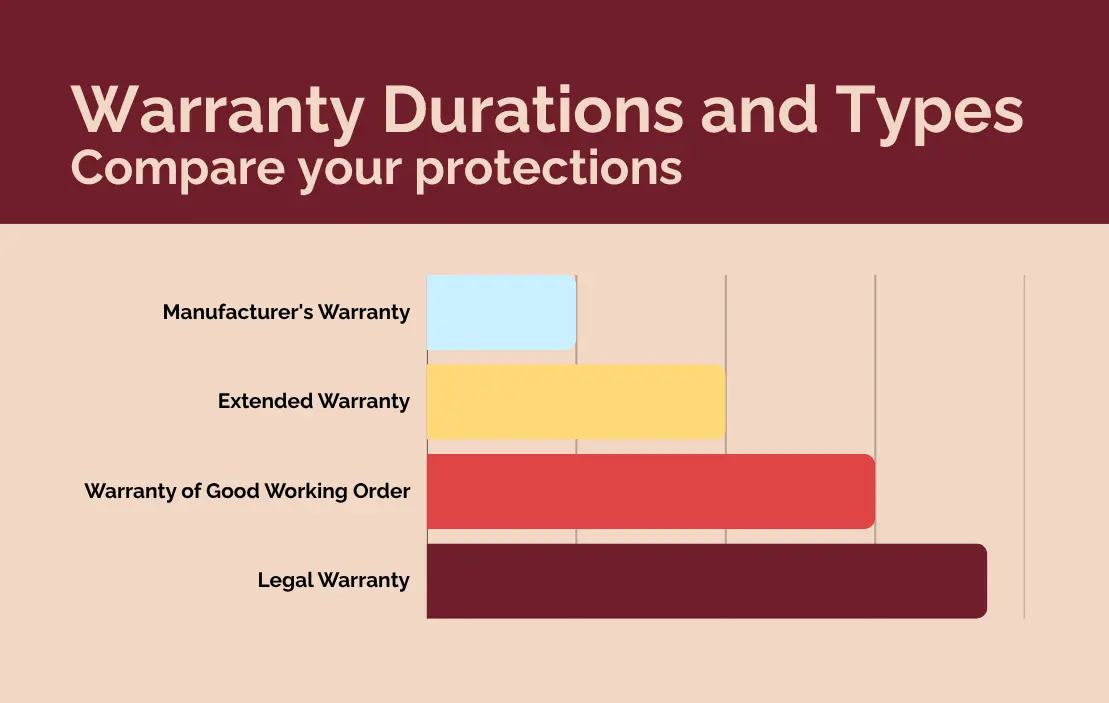
The diagram above compares the durations of the different types of protection available to you, although these may vary depending on the circumstances.
How to enforce your warranty rights?
Before taking action, keep in mind that these different forms of protection complement one another.
Neither the manufacturer’s warranty nor the extended warranty can limit the protection automatically and free of charge provided by law. Likewise, you can continue to exercise your rights under the legal warranty during and after the period covered by the warranty of good working order. This gives you the flexibility to assert your rights based on the nature of the problem, the age of your appliance, the conditions of use, and the price paid.
- Contact the party responsible for honoring the warranty to give them an opportunity to resolve the issue.
- Manufacturer’s warranty: Contact the manufacturer, such as the parent company of your refrigerator’s brand.
- Extended warranty: This depends on your contract. The responsible party may be the retailer that sold you the product or a third-party company specializing in extended warranties.
- Warranty of good working order: Both the retailer and the manufacturer are required to honor this warranty.
- Legal warranty: Both the retailer and the manufacturer are required to honor this warranty.
If you cannot reach an agreement, you can contact the Office de la protection du consommateur to try to resolve the dispute through mediation using the Parle consommation platform (French only), which offers online dispute resolution assistance. This service is free!
Still unable to reach an agreement? You can send a formal notice to the merchant responsible for honoring the warranty. See our formal notice letter template.
- You can also file a claim with the Small Claims Division of the Court of Québec if your claim is for $15,000 or less.
Questions about warranties?
Contact our legal team. Our lawyers will answer your questions free of charge.